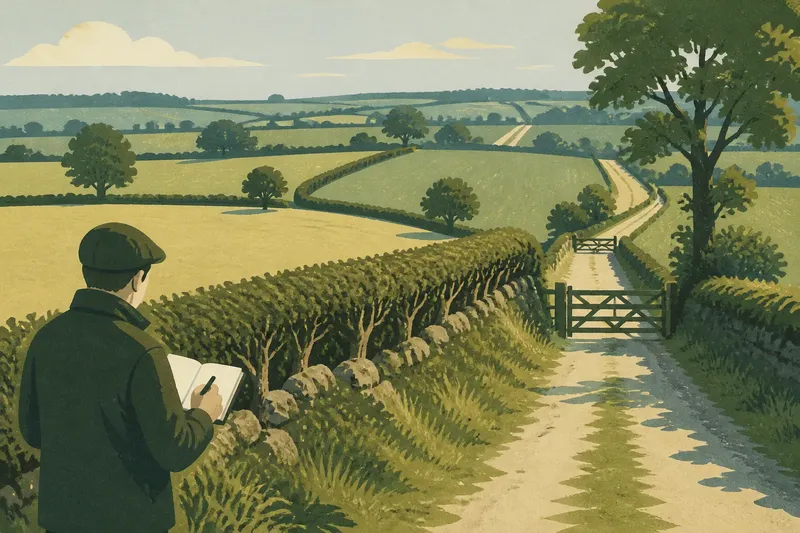
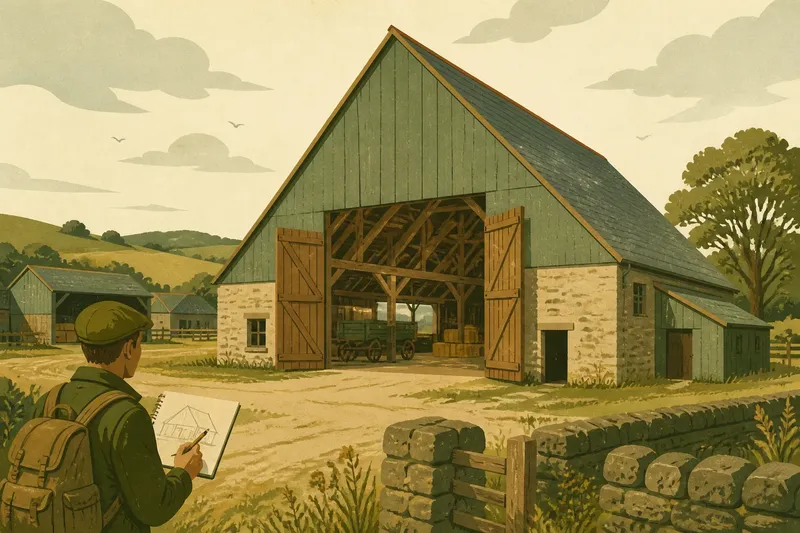
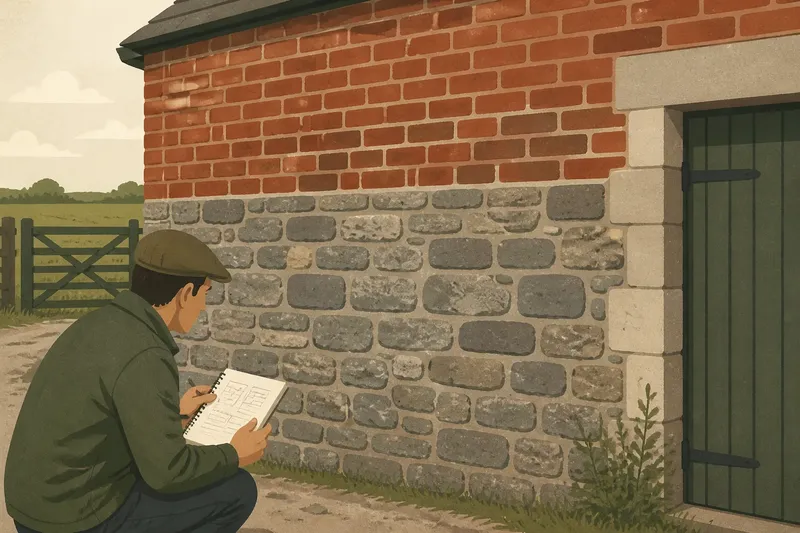
A Winter Walk Around the Farmstead
A winter walk around the farmstead reveals rooflines, tracks and shelter from a public route, helping you choose a safe, respectful way to look.
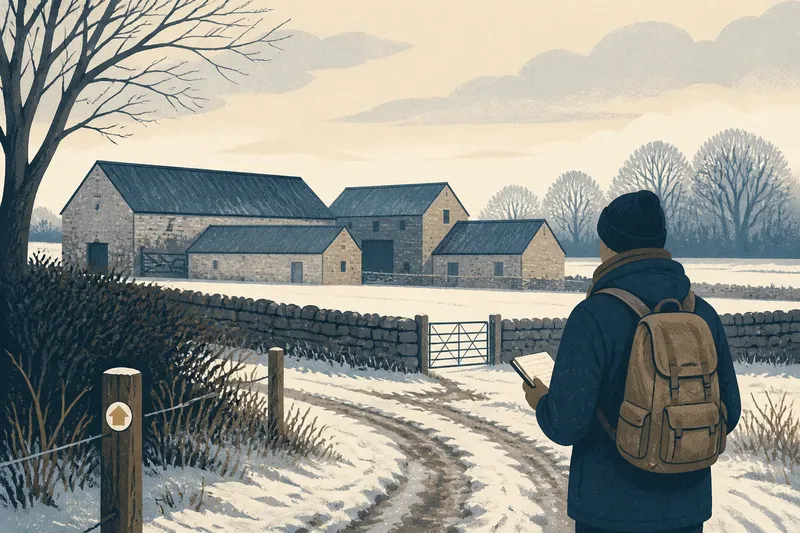
The common mistake on a winter walk around the farmstead is to treat an open-looking gate or yard as an invitation; the cost may be disturbing work, livestock or a private household. A winter walk around the farmstead can instead follow a public lane or established path, using the boundary as a place to observe rooflines, tracks and shelter without entering buildings or unfamiliar land.
Choose your route
Start with the route, not the view. A roadside walk suits anyone who wants a short, simple outing and can keep to a public verge or pavement. An established footpath gives a slower look across fields, but only where its line and access are clear. A loop using both can offer changing angles, provided it does not require crossing a yard or cutting through a field without a marked right of way.
Choose a route that remains legible in poor light and wet weather. Check a current local map for public rights of way, then look for signs and gates on the ground. Do not assume that a farm track is public just because it looks well used. If the route becomes uncertain, turn back rather than improvise across farmland.
- Roadside out-and-back: best for a brief walk or when ground is muddy; keep clear of traffic and do not stop where visibility is poor.
- Marked path beside fields: suits a longer, quieter look; stay on the waymarked line and leave gates as you find them.
- Linked public paths: useful if you want to see the farmstead from more than one direction; choose this only when every connecting stretch is clearly public.
Say you want to look at a group of barns from the lane, but the tempting shortcut runs through an open yard. Stay on the lane, pause at a safe place with a clear view, and note how the roofs overlap from that angle; the result is a useful reading of the farmstead without crossing into its working space.
Read the roofline
From outside the boundary, notice how the buildings sit against the winter sky. A long ridge may follow the slope or run across it; a lower roof may attach to a taller block, while a gap between buildings can reveal a separate range behind. These relationships help you see the farmstead as a group rather than as a collection of isolated roofs.
Walk a little further along the public route before deciding what a roofline means. A change in height that looks like an extension from one viewpoint may resolve into a separate building from another. Look for the roof edge, the meeting of ridges and the way the eaves align with the walls, but resist guessing about hidden interiors or the building’s use from a single glimpse.
Winter’s bare branches can make outlines easier to see, though low sun may throw half the yard into shadow. If the shape is unclear, record the question in a note and revisit the view in different light rather than moving closer to someone’s property.
Follow visible tracks
Tracks can show how movement meets the farmstead, but they do not grant access. From a public path, look for a worn line approaching a gate, a pair of ruts turning towards a yard, or a compacted strip that continues beside a field. Notice where the tracks branch or fade, and whether they appear to serve a field entrance, a building or a route between them.
In winter, rain, frost and fallen leaves alter what is visible. A shallow rut may hold water; fresh marks may be hard to distinguish from older ones. Treat these as clues to the present surface, not proof of who travelled there or when. Keep your own feet on the public route, especially where mud or ice makes the edge uncertain.
A small notebook can help you compare views: sketch the direction of a track, mark the gate in relation to the roofline, and add the date or weather. Avoid photographing people, livestock or private activity without permission.
Compare shelter
The shelter around a farmstead is often easier to read as a sequence. From a safe public viewpoint, notice whether a hedge, tree belt, wall or change in ground blocks the wind before it reaches the buildings. Then look at which sides of the yard appear more exposed. This is a landscape observation, not a reason to cross a boundary to inspect the materials closely.
A roadside view may show the outer edge of a shelter belt well, while a path beside a field may reveal how it continues along a boundary. Each angle has limits: trees can hide buildings, and a hedge may conceal a dip in the ground. Compare what is visible from two lawful viewpoints rather than treating one view as the whole arrangement.
In leafless weather, the shape of a tree belt can stand out, but its apparent gaps may be an effect of the season. Note where shelter seems continuous and where it opens towards a yard or field; leave conclusions about its purpose open unless the layout makes them clear.
Which route suits you?
Is a roadside walk enough?
Yes, if the farmstead can be seen from a safe public place and you mainly want to compare rooflines. Choose a different route if traffic leaves no suitable place to walk or pause.
Can I use a farm track?
Only when it is clearly part of a public right of way or you have permission. A track’s worn surface or open gate does not by itself establish public access.
What should I look at first?
Begin with the outline of the buildings, then look at visible tracks and nearby shelter. This order keeps the walk observational and makes it easier to compare the farmstead with the land around it.
What if the path is muddy or icy?
Use footwear with a secure grip and choose the route that remains firm and passable. If conditions make the public way unsafe or unclear, turn back rather than stepping onto adjoining land.
Keep the walk respectful
Stay on public paths, obey signs and close any gate you use as directed. Give livestock and farm vehicles room, and do not block entrances while stopping to look. Keep dogs under control, particularly near animals, and take litter away with you.
For a winter walk around the farmstead, the best route is the one that lets you see enough without making the working landscape accommodate you. Choose the roadside for a quick roofline view, a marked path for a closer landscape sequence, or a linked route for more than one angle. If access or footing becomes doubtful, the view from the last clear public point is still a good place to stop.