Stone or Brick: Reading a Farm Wall
Stone or brick walls reveal different surfaces, bonds and patterns. Learn what to look for so you can describe a farm building without guessing its age.
The common mistake when reading a farm wall is to treat a rough surface as proof of great age, or a neat one as proof of recent construction. That shortcut can lead to confident but unreliable descriptions. Stone or brick tells you first about visible materials and how they were laid; appearance alone cannot establish when a wall was built.
To describe a wall well, separate three observations: the surface of each unit, the arrangement of those units, and the pattern created across the face. These clues help distinguish stonework from brickwork and one building technique from another, while keeping guesses about age in check.
Start with the units
Brick is usually recognisable by repeated rectangular units with fairly regular faces and consistent courses, the horizontal rows of masonry. Individual bricks may vary in colour, texture or size, especially where they were made by hand, but their edges tend to produce a repeating grid.
Stonework has a broader range of forms. A wall may use squared blocks, roughly dressed pieces with a flatter front, or irregular stones fitted together with more varied joints. Natural differences in grain, colour and outline often remain visible from one piece to the next.
Look closely before deciding what a unit is. A surface coating can hide brick joints or make stone look unusually uniform. Conversely, a brick face may be weathered, spalled or partly covered by mortar, leaving only fragments of its rectangular outline. A small, clear area near a doorway or corner can be more useful than the broadest stretch of wall.
Describe what you can see before naming a building style: “regular red rectangular units” is more precise than “old brick”, and “irregular pale stones with broad joints” says more than “rough stone”.
Read the surface
Brick faces commonly make a repeated pattern of flat rectangles, with mortar lines tracing their edges. The face may be smooth, sand-faced, pitted or marked by firing variation. Brick colours can shift within one wall, so a patchwork of reds, browns or darker tones does not by itself show that different sections were built at different times.
Stone surfaces depend heavily on how each piece was prepared. Rubble masonry may have uneven faces and joints that widen or narrow around the stones. Dressed stone can look orderly, with flatter faces and more carefully aligned edges. Some walls combine rougher material in the main field with better-shaped blocks at corners or openings.
Mortar is part of the visible surface, not just a line between units. Wide joints can make a stone wall appear more irregular; narrow, even joints can sharpen a brick grid. Repointing may also change the look: fresh mortar can sit proud of the masonry, cover part of a brick edge or alter the contrast between units and joints. Record the mortar’s colour and profile separately rather than treating it as evidence of the original finish.
Follow the bond
In brickwork, bond describes how bricks overlap across successive courses. In a common running bond, each brick’s end falls near the middle of the brick below, creating staggered vertical joints. Other arrangements show alternating rows or different patterns on the wall face. The visible pattern can indicate how the face was laid, but it does not necessarily reveal the full construction behind it.
Stonework may also be laid in courses, but the courses can vary in height and the pieces need not repeat like bricks. Rubble may have irregular horizontal lines, with smaller stones packed into gaps. More carefully worked blocks can form straighter courses and more continuous joints. If a wall combines differently sized stones, note whether the pattern is genuinely random or whether broad horizontal bands remain visible.
Check the bond across a broad, unobstructed section. A doorway, window, buttress or repaired patch interrupts the pattern and can make the arrangement harder to follow. At a corner, compare the visible faces: units that turn across the corner help show how the masonry is tied together at the surface, though the wall’s internal construction remains hidden.
Notice pattern changes
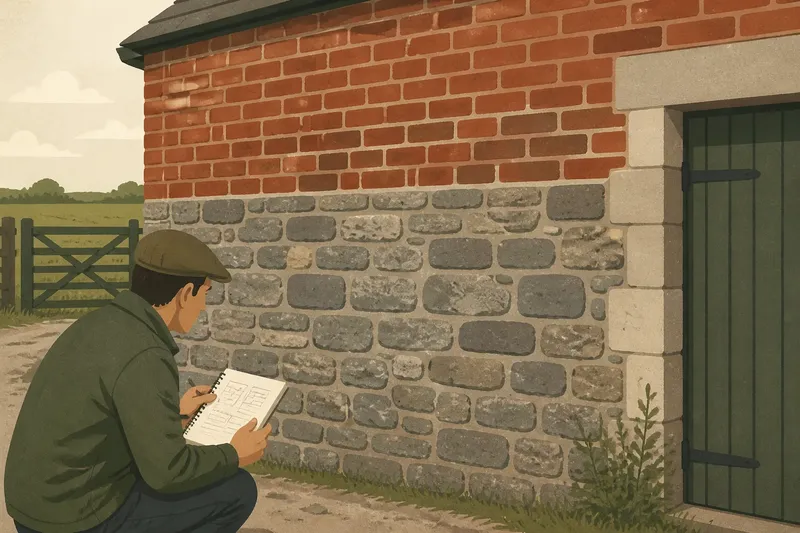
A farm wall need not be made from one material throughout. Brick may frame an opening in a stone wall, or stone may appear in a plinth below brickwork. A change in material can be deliberate, practical, decorative or the result of repair. Describe where it occurs and how it meets the surrounding masonry before proposing a reason.
Look for boundaries that are straight, stepped or uneven. A clean, continuous line between materials is different from a ragged patch that interrupts courses. You might also notice bricks that vary in tone or orientation, stones of a different colour, or mortar that changes abruptly. Such observations can point to a visible alteration, but they cannot date it without other evidence.
Say you are describing a fictional cattle shed with a lower wall of irregular grey stone and an upper band of red brick. You could note that the materials meet along a fairly level line, while brick courses continue around the doorway. That description records the visible relationship without asserting that the brick is a later addition or assigning either section an age.
What can a wall tell you?
Does a rough stone wall prove a building is old?
No. Roughness describes the finish and fit of the visible stones, not a date. Repairs, local building choices and later work can all produce an irregular surface.
Can brick colour identify its age?
Colour can vary with clay, firing, weathering, soiling and replacement. Record the range of tones and any clear change in the wall, but do not use colour alone to assign a period.
What is the difference between bond and pattern?
Bond is the arrangement and overlap of masonry units, particularly in brickwork. Pattern is the broader visual effect made by the units, joints, colour and any changes across the wall.
How should mixed masonry be described?
Name each material and state where it appears, such as stone at the base and brick around an opening. Add how the boundary looks—level, stepped or irregular—without presenting a possible explanation as fact.
Describe, then interpret
A concise wall description can follow a simple order: identify the likely material, describe the unit shapes and surface, explain the bond or courses, then note any changes or repairs. Use words such as “appears”, “visible” and “regular” when the evidence is limited. Avoid “original” or “later” unless another source supports that claim.
For example, “The west wall has irregular limestone rubble in uneven courses, with broad mortar joints and brick around the upper opening” gives a reader concrete details to picture. It also leaves room for uncertainty about when or why the materials were combined.
When looking at stone or brick, the most useful record is not a confident date but a careful account of what the wall actually shows: its units, surface, bond and transitions.